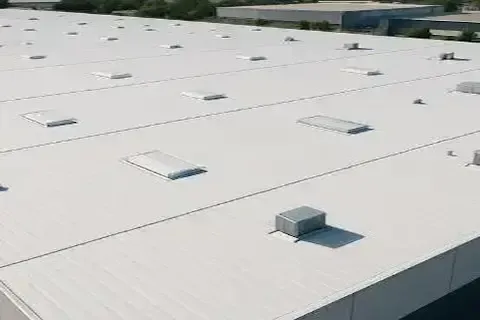
What Roof Lasts Longest on Brooklyn Park Warehouses
Modified bitumen and ballasted EPDM are the longest-lasting roof systems on Brooklyn Park warehouses, typically delivering 30 to 40 years of service life when installed correctly and maintained consistently. TPO membranes are a close third, commonly lasting 25 to 30 years on low-slope industrial structures. The right choice depends on your building's structural load capacity, existing drainage layout, and HVAC penetration count. In Brooklyn Park, MN, where freeze-thaw cycles are severe and summer UV exposure is significant, membrane thickness and seam quality matter more than brand name alone.
Which Roofing Material Lasts Longest on a Warehouse?
Ballasted EPDM consistently ranks at the top for warehouse longevity. The rubber membrane itself is highly resistant to UV degradation, and the stone ballast layer protects it from physical damage and temperature extremes. On Brooklyn Park warehouses with adequate structural capacity to hold the ballast load, this system routinely reaches 35 to 40 years before requiring replacement. Modified bitumen is the strongest competitor, particularly SBS-modified systems with granulated cap sheets. These handle Minnesota's thermal shock well because the rubber modifiers allow the membrane to flex without cracking during the rapid temperature swings common between January and March. For Industrial & Warehouse Roofing projects in Brooklyn Park, both systems outperform standard built-up roofing in long-term cost per year of service.
How Does Minnesota's Climate Affect Warehouse Roof Lifespan?
Brooklyn Park averages over 50 freeze-thaw cycles per year. Every time standing water on a roof surface freezes and expands, it stresses seams, flashings, and membrane edges. Systems that fail earliest in this region are those with brittle membranes or inadequate flashing at parapet walls. Modified bitumen holds up well because its rubberized composition stays pliable at low temperatures. EPDM is similarly flexible. TPO performs well but can be more sensitive to seam failure if the hot-air welding wasn't done under correct conditions during installation. Built-up roofing with gravel surfacing is durable but adds significant dead load and is harder to inspect and repair around the many HVAC curbs typical of warehouse buildings in the Brooklyn Park industrial corridor along Highway 169 and the areas near Zane Avenue North.
Does Roof Thickness Change How Long a Warehouse Roof Lasts?
Yes, significantly. For EPDM, the difference between 45-mil and 90-mil membrane is substantial. Thicker membranes resist puncture from foot traffic, hail, and debris better. On warehouses with rooftop mechanical equipment that requires regular service access, 60-mil or 90-mil EPDM is worth the upfront cost. For modified bitumen, two-ply systems outlast single-ply by a wide margin. A base sheet plus granulated cap sheet system provides redundancy — if the cap sheet is damaged, the base sheet still maintains the water barrier. Warehouses in Brooklyn Park's industrial parks near 85th Avenue North often have high mechanical traffic on the roof, making thickness a practical necessity rather than just a longevity upgrade.
What Maintenance Practices Extend Warehouse Roof Life the Most?
Drainage maintenance is the single highest-impact practice. Blocked interior drains are the leading cause of premature membrane failure on flat warehouse roofs in Minnesota. Water ponding past 48 hours adds dead load stress and accelerates seam deterioration. Clearing drains twice per year — once after leaf fall in October and once after snowmelt in April — adds measurable years to any membrane system. Beyond drainage, bi-annual professional inspections catch flashing separations at parapet walls and curbs before they allow water infiltration. Reviewing your industrial roof system selection against your actual building use and occupancy loads every five years also helps you catch mismatches early. Seam resealing and reflective coating reapplication on TPO and modified bitumen roofs every 10 to 12 years can push service life well beyond baseline projections.
Is TPO Worth Considering for Brooklyn Park Warehouse Longevity?
TPO is worth considering when budget, energy efficiency, and weight are constraints. A fully adhered 60-mil TPO roof installed by an experienced crew delivers 25 to 30 years on a Brooklyn Park warehouse. Its white reflective surface reduces summer cooling loads, which matters for temperature-sensitive warehouse contents. The limitation is seam quality dependence — TPO seams are heat-welded and require skilled installation to achieve full bond strength. Poor seam welds fail within five to seven years in Minnesota freeze-thaw conditions. When properly installed, TPO competes well on cost-per-year-of-service against modified bitumen, though it doesn't reach the same ceiling lifespan as ballasted EPDM.
What Is the Longest Realistic Lifespan for a Brooklyn Park Warehouse Roof?
Under optimal conditions — correct system selection, professional installation, clean drainage, and regular inspections — a ballasted EPDM roof can reach 40 years on a Brooklyn Park warehouse. Modified bitumen two-ply systems regularly achieve 35 years. TPO with proper seam work reaches 30 years. These are realistic upper limits, not marketing claims. Reaching them requires treating the roof as a maintained asset rather than a set-and-forget installation. The warehouses in Brooklyn Park that see premature roof failures are almost always those where drainage maintenance was skipped for multiple seasons or where repairs were deferred past the point of patch viability.
