Brooklyn Park Industrial Roof System Selection Choices
Choosing the right roofing system for an industrial facility in Brooklyn Park, MN involves more than picking the lowest bid or the most familiar product. Warehouse operators, manufacturing plant managers, and distribution center owners face a matrix of performance requirements, budget constraints, and environmental conditions that a poorly matched roof system will expose in the worst possible way — usually during a January cold snap or a midsummer hailstorm. Understanding what separates one commercial membrane system from another helps you make a confident, informed decision before a single crew member sets foot on your roof deck.
Why Industrial Roofing Decisions Differ From Commercial Office Roofing
Industrial facilities impose demands on roofing systems that typical office or retail buildings never encounter. Rooftop HVAC equipment in manufacturing plants creates concentrated load points and vibration transfer. Exhaust stacks from production lines introduce chemical exposure that degrades certain membranes faster than normal weathering. High-bay warehouses often have wider roof spans with fewer internal supports, meaning thermal movement across the membrane is more pronounced. In Brooklyn Park's industrial corridor along Highway 169 and the properties near the Brooklyn Park business park off Zane Avenue, these variables are present in nearly every building type. The roof system you select must be engineered for actual operating conditions, not generic commercial averages.
TPO: The High-Performance Option for Reflective Roofing
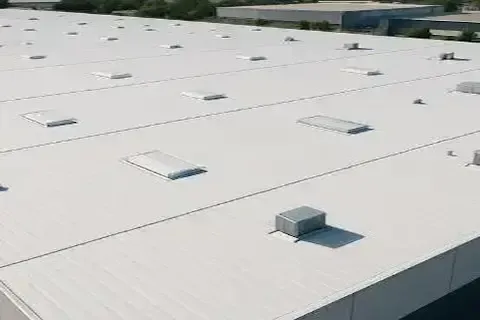
Thermoplastic polyolefin, commonly called TPO, has become the dominant single-ply membrane choice for industrial applications over the past fifteen years. Its white or light-colored surface reflects solar radiation, which matters for large, flat roof expanses where heat gain directly affects cooling loads inside the building. For a distribution center or fulfillment warehouse where temperature-sensitive inventory is stored, that reflectivity translates directly to utility savings.
TPO membranes are heat-welded at the seams, which creates a bond that is structurally stronger than the membrane itself when done correctly. This seam integrity is critical on industrial roofs where wind uplift loads are high. A wide-format warehouse in Brooklyn Park can generate significant negative pressure at roof edges during strong storm systems moving through the Twin Cities metro area, and a mechanically welded seam outperforms adhesive-bonded alternatives in those conditions.
The main caveat with TPO is installation quality. Because the welding process requires properly calibrated equipment and experienced technicians, the performance gap between a well-installed TPO roof and a poorly installed one is large. Welding temperature, speed, and overlap width all affect final seam strength. When you are evaluating contractors for an industrial project, asking for documentation of their welding quality control process is not excessive — it is essential.
EPDM: Proven Durability in Northern Climate Roofing
Ethylene propylene diene monomer rubber, known as EPDM, is the other widely specified single-ply option for industrial roofs in Minnesota. Where TPO offers reflectivity, EPDM offers proven cold-weather flexibility. The material remains pliable at extreme low temperatures, which matters during Brooklyn Park winters where freeze-thaw cycling creates stress on roofing assemblies that can cause brittleness and cracking in less flexible membranes.
EPDM has a long installation and performance history in the upper Midwest. Facility managers who have tracked roof system longevity across multiple buildings often report that properly installed EPDM roofs consistently achieve 20 to 25 years of service life with routine maintenance. For manufacturing facilities where roof replacement requires shutting down production areas, that longevity argument carries real operational weight.
The trade-off with EPDM is that traditional black membrane absorbs heat rather than reflecting it. On a large industrial roof in summer, this can add to cooling loads for climate-controlled spaces. Some manufacturers now offer white EPDM membranes that address this, though they carry a cost premium. For facilities primarily concerned with cold-weather performance and long-term durability over reflectivity, standard black EPDM remains a strong choice.
Modified Bitumen: When Redundancy and Repairability Matter
Modified bitumen roofing systems use asphalt-based materials modified with polymers — typically APP or SBS — that improve flexibility and temperature resistance compared to traditional built-up roofing. Applied in multiple layers, a modified bitumen system creates redundant waterproofing that is more forgiving of minor installation defects than single-ply membranes.
For older industrial buildings in Brooklyn Park where the roof deck is irregular, has been re-roofed previously, or presents challenges for membrane adhesion, modified bitumen's layered approach can accommodate conditions that would compromise a single-ply installation. It is also a system that building maintenance staff can more easily patch and maintain in the field between major service intervals, which appeals to facility managers who handle minor roof repairs internally.
Modified bitumen does carry more installed weight than single-ply membranes, which means structural capacity of the deck must be confirmed before specification. It also involves more complex installation logistics — torch-applied systems require fire watch protocols and careful coordination around rooftop equipment and combustible materials, which is a real consideration on active manufacturing sites.
Insulation Specifications That Industrial Roofs Cannot Ignore
Membrane selection gets most of the attention in industrial roofing conversations, but insulation specification often determines whether an industrial roof system performs as designed. Minnesota's climate requires significant R-value in commercial roofing assemblies to meet code minimums, but the distribution and type of insulation matter as much as total R-value.
Polyisocyanurate, or polyiso, is the standard choice for industrial roof insulation in the Twin Cities area. It delivers high R-value per inch, which is important when parapet height limits overall system thickness. However, polyiso's R-value decreases at low temperatures — a phenomenon called thermal drift — which means nominally specified assemblies can underperform during Minnesota winters. Specifying slightly above code minimum compensates for this effect in extreme cold conditions that Brooklyn Park facilities experience regularly.
For facilities with high internal humidity — food processing operations, certain manufacturing environments, or distribution centers with significant refrigeration equipment — a vapor retarder specification is often necessary to prevent interstitial condensation from degrading insulation performance over time. Ignoring vapor management in humid industrial environments leads to progressive insulation degradation that reduces thermal performance without any visible surface symptoms until significant damage has occurred.
Making the Selection Decision: A Practical Framework
The decision framework for industrial roof system selection in Brooklyn Park starts with three questions: What are the dominant performance requirements for this specific facility? What is the realistic total cost of ownership over the expected service period, not just the installation cost? And who is actually going to install it?
For reflectivity and energy performance, TPO leads. For cold-weather flexibility and proven longevity in northern climates, EPDM is the benchmark. For redundancy, repairability, and compatibility with challenging deck conditions, modified bitumen earns its specification. No single system is universally superior — the right answer depends on your building, your operations, and your maintenance program.
If you want a detailed breakdown of how these systems compare across Brooklyn Park industrial building types, the industrial roofing manual covers performance criteria, life cycle costing, and maintenance expectations in depth. When you are ready to evaluate your specific facility, connecting with a contractor who understands Industrial & Warehouse Roofing at the scale and complexity of Brooklyn Park's industrial base is the logical next step toward a specification you can defend.
