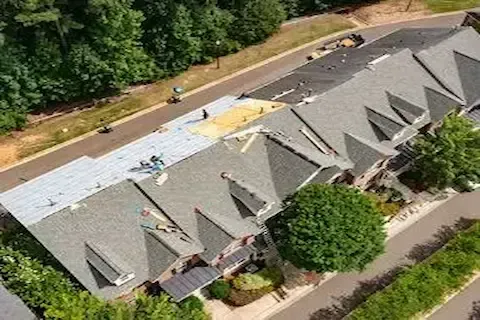
Townhome Roof Replacement in Brooklyn Park MN Communities
Replacing a roof on a townhome in Brooklyn Park, MN is a fundamentally different undertaking than swapping out shingles on a single-family house. The moment you introduce shared walls, common eaves, and a homeowners association into the equation, every decision — from material selection to project scheduling — carries consequences for multiple parties. Hennepin County's permit requirements, the HOA's governing documents, and the practical realities of working on attached structures all converge at once. If you manage a townhome association or serve on a board in communities like Edinburgh, Edinbrook, or the Fountains, understanding how that convergence works will save you significant time, money, and friction with residents.
Why Townhome Roofing Projects Are Structurally Distinct
Single-family roofs are discrete units. A townhome roof is not. Even when individual units appear to have their own rooflines, those planes often share a continuous deck that runs across party walls, meaning a failure on one section can affect moisture infiltration into a neighboring unit. That shared nature changes everything about how replacement projects are scoped.
Contractors working in Brooklyn Park HOA communities must account for:
- Continuous decking across multiple units — Tearing off only one unit's shingles while leaving adjacent sections intact creates mismatched aging and potential leak pathways at the seams.
- Party wall flashing — Where two units meet at a vertical wall, the flashing detail is critical. Improper reinstallation during a partial replacement is one of the most common sources of post-project callbacks in attached housing.
- Ventilation continuity — Ridge vents and soffit intake systems often run across the full building rather than per unit. Replacing one section without addressing the full ventilation profile can create pressure imbalances that accelerate moisture accumulation in adjacent attic spaces.
- Gutter and downspout coordination — Many Brooklyn Park townhome associations share gutter runs. A reroof that changes the drip edge profile or fascia board condition requires coordinated gutter work, not unit-by-unit patchwork.
These aren't edge cases. They're standard conditions in attached housing, and they're why Multi-Family & HOA Roofing requires a different planning framework than residential work.
How HOA Boards Navigate the Approval Process
In most Brooklyn Park townhome associations, the roof is classified as a common element — meaning the HOA is responsible for maintenance and replacement, not individual unit owners. That classification sounds straightforward until you reach the funding and approval stage.
Most HOA governing documents require a board vote before any capital improvement expenditure above a set threshold. For a full-building reroof, that threshold is almost always met. Boards typically need to:
- Obtain a minimum of two or three contractor bids documented in writing
- Present the bids at a board meeting with proper notice to all members
- Vote by majority — or in some cases supermajority — depending on the declaration language
- Notify unit owners of the approved scope, timeline, and any assessment impact before work begins
Skipping steps in this sequence doesn't just create internal association disputes. It can expose board members to personal liability claims from unit owners who allege procedural violations. Associations governed under Minnesota Statutes Chapter 515B — the Minnesota Common Interest Ownership Act — have specific notice and meeting requirements that apply to capital expenditures, and HOA boards in Brooklyn Park should review those provisions with their association attorney before executing contracts.
Resident Notice and Logistics Coordination
Once the board vote is complete and the contract is executed, resident communication becomes the next operational challenge. A reroof on an attached building involves heavy equipment, dumpster placement, material staging, and noise — all of which affect the daily lives of every unit owner in the affected building or buildings.
Best practices for Brooklyn Park HOA reroof projects include:
- Written notice at least 14 days in advance — This gives residents time to arrange parking, move vehicles from affected driveways, and make any accommodations for noise-sensitive household members.
- Dumpster placement planning — In dense townhome communities, dumpster location affects traffic flow and parking availability. Coordinate with the contractor before the notice goes out so residents receive accurate information about where staging will occur.
- Vehicle protection advisories — Shingle debris and fasteners can damage vehicles parked adjacent to work areas. Notify residents to relocate vehicles from directly beneath active work zones.
- Construction hours disclosure — Brooklyn Park municipal code restricts construction noise to daytime hours. Include the expected daily start and stop times in resident communications.
- Point-of-contact clarity — Designate a board member or property manager as the primary contact for resident questions during the project. This prevents residents from approaching the crew directly, which slows production and creates scope confusion.
Permit and Inspection Requirements in Brooklyn Park
The City of Brooklyn Park requires a building permit for full roof replacements, including those on attached residential structures. For townhome communities, this typically means a single permit pulled for the entire building rather than per-unit permits, though that can vary depending on how the property is platted and recorded with Hennepin County.
Your contractor should pull the permit before work begins. If a contractor asks you to pull the permit as the property owner or HOA, treat that as a caution flag — licensed contractors in Minnesota are authorized to pull their own permits and typically prefer to do so because it keeps liability clearly assigned. The city's inspections division will schedule a final inspection after the project is complete, and the contractor's license and insurance information will be tied to that permit record.
Selecting the Right Contractor for an HOA Reroof
Not every contractor who handles residential roofing in the Minneapolis suburbs is equipped to manage the coordination demands of an HOA project. When evaluating bids for a Brooklyn Park townhome reroof, ask specifically about:
- Experience with multi-building attached structures — not just single-family or light commercial
- Familiarity with HOA board documentation requirements, including insurance certificates naming the association as additionally insured
- References from comparable projects in Hennepin County or the northern metro
- A written project schedule that accounts for phased work across multiple buildings if applicable
- A clear protocol for documenting pre-existing damage discovered during tear-off, which is common in older Brooklyn Park communities built in the 1980s and 1990s
For a deeper look at how attached housing roofing projects differ across project types and building configurations, review the multi-family handbook before your board finalizes its contractor selection criteria.
Material Considerations for Minnesota Climates
Brooklyn Park's freeze-thaw cycle, ice dam exposure, and periodic severe hail events all shape which roofing materials perform well over time. For townhome associations, material uniformity across a building or community is also an HOA aesthetic concern — most governing documents require consistent appearance across all units.
Class 4 impact-resistant shingles have become increasingly common in the northern metro because they qualify for insurance premium discounts with many carriers and resist hail damage better than standard architectural shingles. Many Brooklyn Park associations that have experienced repeated storm claims are now specifying impact-resistant products in their reroof scopes as a loss-mitigation strategy. Confirm with your association's insurance carrier whether the premium credit applies before finalizing material specifications — the savings can meaningfully offset the modest cost premium for upgraded shingles.
Planning Ahead in Brooklyn Park HOA Communities
Townhome roof replacement in Brooklyn Park is a project that rewards early planning and penalizes reactive decision-making. Boards that wait until active leaks appear before beginning the bid process typically face compressed timelines, reduced negotiating leverage, and emergency repair costs on top of replacement costs. Reserve study schedules and annual roof inspections — particularly after significant hail events that affect the north metro — give associations the lead time they need to manage this process properly. The communities that handle it well treat roofing not as a crisis response but as a predictable capital event they've been preparing for.
