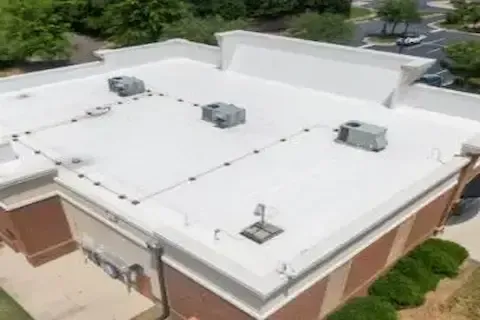
When to Replace a Brooklyn Park Commercial Flat Roof
A flat roof that keeps leaking isn't just a maintenance nuisance — it's a financial liability that compounds quietly until the cost of inaction overtakes the cost of replacement. For commercial property owners in Brooklyn Park, MN, knowing when to stop repairing and start replacing is one of the most consequential decisions you'll make for your building's long-term value. The challenge is that flat roofs rarely fail all at once. They deteriorate gradually, and without a clear framework for evaluating that deterioration, it's easy to stay in repair mode long past the point where it makes economic sense.
Understanding Membrane Age and What It Actually Means
Every commercial flat roof membrane — whether TPO, EPDM, modified bitumen, or built-up roofing — carries a realistic service life range. TPO and EPDM systems installed correctly under favorable conditions typically perform well for 20 to 30 years. Modified bitumen systems average 15 to 25 years. Built-up roofing sits in a similar range depending on the number of plies and maintenance history.
When your system is approaching or beyond its expected service life, the calculus on repairs changes dramatically. A roof that has 18 years of wear on it and starts leaking isn't just one leak — it's a system-wide signal. The membrane has lost elasticity, seams have stress-fatigued, and flashings have cycled through enough freeze-thaw expansion to compromise their bonds. Brooklyn Park's climate accelerates this process. Winters here push well below zero, and the thermal cycling that occurs between January lows and July highs places substantial mechanical stress on any roofing membrane year after year.
Age alone doesn't mandate replacement, but age combined with any of the warning signs below almost always does.
The Warning Signs That Point Toward Replacement
Recurring leaks are the most obvious indicator, but the pattern of those leaks matters more than the frequency. If water intrusion happens in the same location repeatedly after targeted repairs, that's a maintenance issue. If leaks are appearing in new locations each season — or appearing at multiple points after a single rain event — the membrane itself has reached systemic failure. No amount of patch work addresses systemic failure cost-effectively.
Standing water that persists more than 48 hours after rainfall is a serious concern on any flat roof. While all flat roofs are designed with some slope for drainage, chronic ponding accelerates membrane degradation, adds structural load, and signals that either the drainage system is compromised or the deck below has deflected. In either case, a roof inspection for Brooklyn Park commercial buildings experiencing ponding should include a structural assessment, not just a surface repair estimate.
Membrane blistering, bubbling, and surface granule loss on modified bitumen systems are visible indicators of accelerated aging. Blisters form when moisture becomes trapped beneath the membrane and expands with heat — a cycle that weakens adhesion bonds and creates entry points for water. Once blistering becomes widespread, the membrane's waterproofing integrity is compromised across its full area, not just at the visible blisters.
Interior signs are equally telling. Water staining on ceiling tiles, rust streaks on steel decking visible from inside, or insulation that smells musty when disturbed during a renovation — these all indicate that moisture has already penetrated the membrane and is working into the building assembly. By the time you can see moisture damage inside, it has typically been accumulating for months.
Deck Condition Is the Factor That Changes Everything
The roofing membrane gets most of the attention, but the deck beneath it determines whether replacement is straightforward or significantly more involved. Steel decking that has rusted through, wood decking that has rotted, or concrete decking that has spalled requires remediation before a new membrane can be installed. If deck damage is extensive, the project scope and cost increase substantially — but the deck damage itself is caused by prolonged moisture intrusion, which means delayed replacement is directly responsible for turning a membrane replacement into a structural repair.
This is the most compelling argument for acting early. A roof replaced when the membrane has failed but the deck remains intact is a much more predictable, cost-controlled project than one where deck replacement is required. Getting ahead of deck deterioration is where replacement timing decisions pay off most clearly for Brooklyn Park commercial property owners.
The Repair-Versus-Replace Lifecycle Calculation
Roofing contractors and property managers use a general benchmark: when annual repair costs reach 25 to 30 percent of the estimated replacement cost, replacement typically delivers better long-term value. This isn't a rigid formula, but it provides a useful reference point when evaluating bids on successive repair projects.
There's also the disruption factor. Every emergency repair means service calls, interior protection, business interruption, and tenant relations issues if the building is leased. A replacement project, while larger in upfront cost, eliminates that recurring disruption for 20-plus years. For Brooklyn Park commercial buildings with sensitive inventory, occupied tenant spaces, or temperature-controlled operations, the operational cost of recurring leaks often exceeds the repair invoices themselves.
For a detailed walkthrough of what the replacement process involves from initial assessment through final installation, the roof replacement roadmap covers the full scope of what property owners should expect at each stage.
Local Conditions That Accelerate Flat Roof Deterioration
Brooklyn Park sits in a climate zone that tests commercial roofing harder than most parts of the country. The freeze-thaw cycle here isn't a seasonal event — it's a recurring weekly occurrence during shoulder seasons. In March and November, temperatures commonly swing above and below freezing multiple times in a single week, each cycle expanding and contracting the membrane, its seams, and its flashings.
Ice damming on flat roofs with poor drainage or inadequate insulation contributes to edge and flashing failures that are often misdiagnosed as seam failures. Snow load accumulation on large commercial roofs in the Brooklyn Park area can also mask ponding problems that only become visible after the spring melt — by which point moisture infiltration may have already occurred through weakened seams. These local realities mean that replacement timelines appropriate for commercial buildings in milder climates may need to be moved forward for properties in this part of Minnesota.
What to Do Before You Commit to Replacement
Before authorizing a replacement project, commission a formal roof assessment from a qualified commercial roofing contractor — not a patch-and-go service call, but a comprehensive evaluation that includes infrared moisture scanning if subsurface moisture is suspected. Infrared scanning identifies wet insulation without destructive testing, giving you a map of where moisture has already penetrated and helping quantify how much of the roof assembly is affected.
Document your repair history with dates, costs, and locations. This record serves two purposes: it helps a contractor understand the failure pattern, and it gives you the data to run the lifecycle calculation yourself. If you've spent 18,000 dollars on repairs over four years on a roof with an estimated replacement cost of 60,000 dollars, that history makes the financial case clearly.
Commercial Roof Replacement services in Brooklyn Park are structured to begin with that diagnostic foundation — establishing what the roof actually needs before recommending scope, not after.
The Right Timing Is Earlier Than Most Property Owners Expect
The pattern across commercial roofing projects in the Brooklyn Park area is consistent: property owners who replace a failing flat roof on a planned schedule come out ahead of those who extend the repair cycle until failure forces the issue. Planned replacement allows you to choose the right season, negotiate competitive pricing, coordinate with tenants, and avoid emergency premium costs. Forced replacement — after a catastrophic leak event or structural compromise — removes every one of those advantages.
If your flat roof is showing more than one of the warning signs described here, the replacement conversation is overdue. The cost of getting that evaluation is negligible compared to the cost of another season of reactive repairs.
