Modified Bitumen vs TPO for Brooklyn Park MN Buildings
Choosing between modified bitumen and TPO for a flat or low-slope commercial roof in Brooklyn Park, MN is not a theoretical exercise. Both systems work. Both fail when installed or maintained poorly. The difference comes down to how each material behaves under Minnesota's specific climate stress, what your building structure can support, how your maintenance team operates, and what your 30-year cost picture looks like. This comparison focuses on practical performance factors relevant to commercial property owners and facilities managers in the Brooklyn Park area.
How Each Material Is Built and Why It Matters
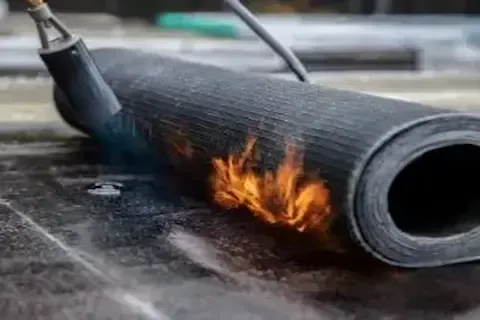
Modified bitumen is an asphalt-based system reinforced with either APP (atactic polypropylene) or SBS (styrene-butadiene-styrene) polymers. APP-modified sheets are typically torch-applied, while SBS sheets can be cold-adhesive or heat-welded. The result is a multi-layer membrane that behaves much like traditional built-up roofing but with improved flexibility and tear resistance. Modified bitumen has a long track record on commercial buildings in the Upper Midwest precisely because it was engineered with temperature extremes in mind.
TPO, or thermoplastic polyolefin, is a single-ply membrane that has grown rapidly in market share over the past two decades. It is heat-welded at the seams using hot air, creating bonds that can actually exceed the strength of the membrane itself when done correctly. TPO is lighter than modified bitumen, reflective by default in its white formulation, and generally faster to install on large open roof decks. However, its performance record in extreme cold climates is shorter, and early-generation TPO had documented issues with seam brittleness and premature aging.
Cold Weather Performance in Brooklyn Park Conditions
Brooklyn Park sits squarely in USDA Hardiness Zone 4b, with January averages dropping well below zero and temperature swings of 60 or more degrees between seasons. This thermal cycling is the primary stress factor for any flat roofing membrane.
SBS-modified bitumen was specifically formulated for cold flexibility. The SBS polymer modifier allows the membrane to remain pliable at temperatures as low as -20°F, meaning it can expand and contract with the roof deck without cracking or delaminating at seams. For older commercial buildings in Brooklyn Park where the deck may shift or settle, this flexibility is a meaningful structural advantage.
Modern TPO formulations have improved significantly from early versions, and current third-generation membranes perform reasonably well in cold climates. That said, TPO seams remain a watch point. Heat-welded seams require precise installation temperature and technique. In Minnesota winters, contractor experience with cold-weather welding procedures matters more for TPO than for modified bitumen. A poorly welded TPO seam in November can become a leak point by February.
Installation Considerations for Commercial Buildings
Modified bitumen installation carries one significant liability in urban commercial settings: torch application involves open flame near combustible materials. In Brooklyn Park industrial parks and retail centers, particularly buildings with rooftop HVAC equipment, parapets, or skylights, torch application requires experienced crews with strict fire watch protocols. Cold-adhesive SBS systems eliminate the open flame issue but require longer cure time and specific ambient temperature conditions.
TPO installation is cleaner and faster for large, unobstructed roof decks. A skilled crew with hot-air welding equipment can cover significant square footage per day with fewer fire-related concerns. For building owners managing occupied commercial space below, the reduced disruption of TPO installation is a real-world advantage. On the other hand, TPO around penetrations, curbs, and parapets requires more detailed flashing work, and those details are where inexperienced installers most often create future problems.
If your Brooklyn Park commercial property has significant rooftop equipment, multiple penetrations, or an irregular shape, the quality of the contractor's detailing work matters more than the membrane choice itself. This is true for both systems. For Modified Bitumen Roofing specifically, the torch application around penetrations requires particular skill to avoid overheating adjacent surfaces while achieving complete adhesion.
Repair Patterns and Long-Term Maintenance
One of the most practical differences between these two systems shows up in the repair phase, not the installation phase.
Modified bitumen is forgiving to repair. A facilities team with basic training can patch a modified bitumen roof using peel-and-stick membrane patches or cold-applied asphalt mastic. You do not need specialized equipment on the roof for routine repairs. This matters for commercial building owners in Brooklyn Park who may have in-house maintenance staff handling minor issues between scheduled inspections.
TPO repairs require a hot-air welder to properly bond patches. Without proper equipment and technique, a TPO repair may appear complete but fail at the bond line within a season. This means every TPO repair should realistically involve a qualified roofing contractor. For some building operators, that added dependency translates to higher long-term maintenance costs than the initial installation savings suggest.
Both systems benefit from biannual inspections, ideally in spring and fall, to catch winter damage and prepare for freeze-thaw cycles. Reading about summer modified bitumen care gives you a practical baseline for what seasonal maintenance looks like on bitumen systems through the warmer months.
Energy Performance and Building Codes
TPO's reflective white surface delivers a meaningful energy advantage in summer, reducing cooling loads for conditioned commercial space. In Brooklyn Park, where retail and office buildings run air conditioning through a genuine summer season, that reflectivity can offset energy costs. However, Minnesota's heating-dominated climate means the annual energy calculus is more nuanced than in southern states. A white reflective roof that saves on cooling in July may contribute to slightly higher heating loads in winter compared to a darker modified bitumen surface that absorbs solar gain on cold days.
Minnesota energy codes and local utility rebate programs have historically rewarded high-albedo roofing in commercial applications. If your building qualifies for Xcel Energy or CenterPoint rebate programs based on roofing upgrades, the energy modeling specific to your Brooklyn Park facility should inform this part of the decision.
Thirty-Year Lifecycle Comparison
When you project costs across the full service life of a commercial roof, both systems can perform well or poorly depending on installation quality and maintenance commitment. Modified bitumen, properly installed and maintained, routinely achieves 20 to 25-year service life with a recoverable surface that can often be re-coated before full replacement. TPO systems with quality membranes and correct installation are warranted at 15 to 20 years by most manufacturers, with some third-generation products carrying 30-year warranties under specific conditions.
For Brooklyn Park commercial property owners, the decision often comes down to three factors: the skill and experience level of available roofing contractors with each system, the complexity of your rooftop geometry and penetrations, and your in-house maintenance capability for ongoing repairs. A premium TPO installation by a contractor with strong cold-climate TPO experience can outperform a mediocre modified bitumen installation, and vice versa. The material is secondary to the execution in Minnesota's climate.
Making the Right Call for Your Property
If your Brooklyn Park commercial building has an older deck that may exhibit movement, a maintenance team capable of basic repairs, or existing modified bitumen layers that allow for a recover installation, modified bitumen is likely the lower-risk path. If you have a large open roof deck, prioritize energy efficiency, and are working with a contractor whose crew has documented cold-climate TPO welding experience, TPO can be a cost-effective long-term solution. Neither system is universally superior. The right answer is the one matched to your specific building, your maintenance resources, and your contractor's demonstrated expertise with that material in Minnesota conditions.
