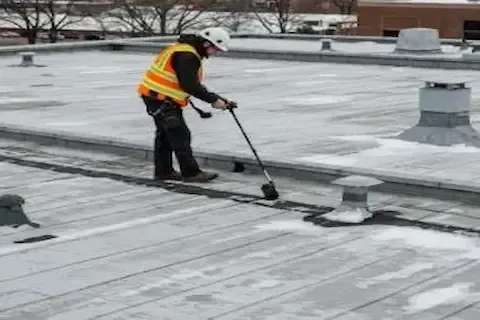
Fall Roof Inspections for Brooklyn Park Commercial Sites
Why Autumn Is the Right Time to Inspect Your Commercial Roof in Brooklyn Park
Brooklyn Park commercial property owners face a narrow but critical window every fall. Between the last stretch of warm weather and the first hard freeze across Hennepin County, there is a brief period when roof surfaces are still accessible, adhesives cure properly, and repair crews can work efficiently. Miss that window, and what was a minor seam separation or a partially blocked interior drain in October becomes a mid-January failure that shuts down operations, damages inventory, and generates emergency repair costs that dwarf what a scheduled inspection would have cost. Fall roof inspections are not precautionary formalities — they are the most cost-effective maintenance decision a Brooklyn Park commercial property manager can make before winter arrives.
What a Full Summer Season Does to a Flat Commercial Roof
Minnesota summers are harder on commercial roofing membranes than most property owners realize. Between May and September, rooftop surface temperatures on a dark TPO or modified bitumen membrane regularly climb above 160 degrees Fahrenheit during peak sun hours. That thermal cycling — expanding during the day, contracting at night — stresses every seam, penetration flashing, and field splice on the roof. By the time Labor Day passes, those cumulative stress cycles have done real work on the membrane, even on roofs that are only a few years old.
Add summer hail events to the picture and the risk compounds. The Minneapolis-St. Paul metro, including the Brooklyn Park corridor along Interstate 694, sees multiple hail-producing storms most summers. Impact damage to TPO membranes, EPDM, and built-up roofing systems is not always visible from ground level. Small punctures, bruised membrane that will crack under freeze-thaw stress, and dented metal coping caps all require close-up inspection to identify. A fall inspection catches this damage while it is still repairable before standing water freezes inside a compromised area and forces its way deeper into the insulation layer.
The Specific Conditions an Inspector Looks for in October and November
A thorough fall inspection on a Brooklyn Park commercial site covers more than a visual walk of the field membrane. Here is what a qualified inspector systematically evaluates before signing off on a pre-winter condition report:
- Drain bowls and interior drains: Summer debris — cottonwood fluff, gravel migration, leaves — accumulates in drain bowls. A partially blocked drain that ponds water going into a freeze cycle will hold ice on the membrane for weeks, accelerating edge degradation.
- Seam integrity across the full membrane: Heat-welded TPO seams and adhered EPDM seams both show stress points after a full summer of thermal cycling. Probing seams by hand and using a pull test at suspect locations identifies separations before they become open water pathways.
- Flashing at all penetrations: HVAC curbs, pipe boots, conduit penetrations, and skylight frames are the highest-probability leak origin points on any flat commercial roof. Flashing that lifted slightly in summer heat may not yet leak, but it will not survive freeze-thaw pressure without intervention.
- Metal coping and edge termination: Brooklyn Park properties near open land on the city's northern edges face persistent wind loading. Coping caps that have shifted or lost their clip connections allow water to enter the wall assembly at the parapet — a failure mode that generates interior damage well away from where the entry point is visible.
- Roof drains and scuppers for hail denting: Hail-dented scupper covers and compressed insulation around drain fields are indicators of impact events that warrant a full membrane impact assessment, especially if the property has not filed a recent insurance claim.
Understanding how often this type of evaluation should occur, and why annual inspections alone are not always sufficient, is covered in detail in our inspection frequency basics article, which outlines the scheduling logic behind multi-season commercial roof maintenance programs.
Timing the Inspection Correctly for Hennepin County Winters
Brooklyn Park's position in Hennepin County means the freeze line typically arrives in earnest by mid-to-late November. Scheduling your fall inspection in early to mid-October gives a repair crew a realistic window to complete any identified work before cold temperatures prevent proper adhesive bonding and membrane welding. TPO heat-welded repairs require ambient temperatures above 40 degrees Fahrenheit to cure correctly. Modified bitumen torch work and adhesive applications have similar constraints. A November 15th inspection that reveals needed repairs may result in emergency temporary patching rather than a proper long-term repair, simply because the temperature window for quality work has closed.
Property managers overseeing multiple buildings in the Brooklyn Park and Maple Grove corridor should stagger inspection scheduling across September and October rather than booking everything simultaneously. Roofing crews with commercial flat-roof experience have limited fall availability, and waiting until late October to schedule leaves you competing for contractor time with every other commercial property in the metro that delayed the same decision.
Insurance Documentation and Hail Damage Claims
One practical reason to conduct a formal fall inspection rather than an informal walk-through is documentation. If a summer hail event damaged your roof membrane and you have not yet filed an insurance claim, a professional inspection report with photographs and membrane condition notes creates the baseline documentation that supports a claim. Many Brooklyn Park commercial property owners are unaware that hail damage claims have a filing window that varies by policy — and that an undocumented, undetected impact event from July becomes significantly harder to pursue by February.
A written fall inspection report also establishes a dated baseline for your roof's condition. If a leak develops in January, that report demonstrates what the roof's condition was before winter — which matters both for insurance purposes and for any contractor warranty discussions.
Choosing an Inspector with Flat Roof and Low-Slope Experience
Brooklyn Park's commercial building stock spans industrial, retail, and mixed-use properties from the Bass Lake Road commercial district to the newer developments near the city's west edge along Highway 169. Many of these buildings carry flat or low-slope roofs — TPO, EPDM, modified bitumen, and PVC systems — that require inspectors who understand membrane mechanics, not just slope-and-shingle residential roofing. When selecting an inspector, confirm their documented experience with commercial low-slope systems, their familiarity with the specific membrane manufacturer's warranty requirements on your building, and their ability to provide a written condition report rather than a verbal opinion.
Booking a Commercial Roof Inspection before the October weather window closes gives your property the documented foundation for winter preparedness, insurance compliance, and repair prioritization that a Minneapolis-area winter demands.
Making the Inspection Count Before the First Freeze
A fall roof inspection is only as useful as the action it generates. The goal is not a clean report — it is a clear picture of what needs immediate repair, what can be monitored through winter, and what should be budgeted for spring. Brooklyn Park commercial property managers who treat the fall inspection as the start of a documented maintenance cycle, rather than a one-time check, consistently see lower emergency repair costs, longer membrane lifespans, and fewer weather-related business interruptions when January temperatures drop below zero and stay there for weeks at a stretch.
