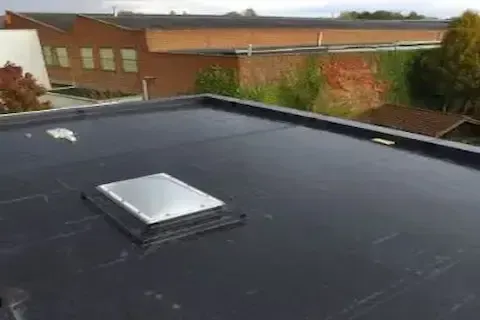
EPDM vs TPO Lifecycle for Brooklyn Park Commercial
Choosing between EPDM and TPO for a commercial flat roof in Brooklyn Park, MN is less about which membrane is better in the abstract and more about which one holds up over a realistic 20-to-25-year ownership window in this specific climate. Both materials dominate the low-slope commercial roofing market, and both can serve a building well — but they age differently, fail differently, and cost differently to maintain across that span. Before you sign off on a replacement or new installation, it pays to map out what each system actually looks like at year five, year twelve, and year twenty under Minnesota conditions.
How EPDM and TPO Are Fundamentally Different
EPDM (ethylene propylene diene monomer) is a synthetic rubber membrane that has been installed on commercial rooftops since the 1960s. TPO (thermoplastic polyolefin) became commercially widespread in the 1990s as a heat-weldable, reflective alternative. The core difference is chemistry: EPDM is a thermoset rubber, meaning once it cures it cannot be re-melted. TPO is thermoplastic, meaning seams are hot-air welded and the membrane can be reformed with heat. That distinction drives nearly every performance difference you will encounter over a building's life.
EPDM is typically installed in black, which absorbs heat. TPO is installed in white or light gray, which reflects it. In a Brooklyn Park summer that can push surface temperatures above 150°F on a dark roof, TPO's reflectivity reduces cooling loads. In a Brooklyn Park winter where rooftop temperatures drop below -20°F, EPDM's rubber chemistry maintains flexibility while TPO can become brittle if the formulation is below specification.
Cold-Weather Performance Over Time
Minnesota's freeze-thaw cycle is the single most important stress factor for flat roof membranes. Water infiltrates micro-seams, freezes, expands, and widens the opening. Over enough cycles, seam failures become the dominant repair category for any low-slope system.
EPDM seams are bonded with adhesive or tape rather than heat welded. In the first five years, a properly installed EPDM roof has relatively few seam issues because the adhesive bond is intact. Between years eight and fifteen, adhesive-set seams can begin to separate, particularly on roofs with heavy foot traffic or HVAC equipment that creates localized stress. The repair for an open EPDM seam is straightforward — clean, apply new seam tape or contact cement, and re-press — and can often be handled without replacing large sections.
TPO seams, when heat-welded correctly, are chemically fused and can outlast adhesive bonds by a significant margin. A properly welded TPO seam is essentially as strong as the field membrane itself. The vulnerability in cold climates is at penetrations and flashings, where movement from thermal cycling stresses the interface between the membrane and the counterflashing. Early TPO formulations from the late 1990s had plasticizer migration problems that caused brittleness; products installed today from reputable manufacturers are substantially improved, but the formulation quality of what was installed on your Brooklyn Park building a decade ago matters considerably to where you are in that lifecycle.
Repair Costs Across a 25-Year Ownership Window
A realistic cost comparison requires thinking in three phases: installation, mid-life maintenance, and end-of-life replacement.
At installation, TPO typically runs slightly higher per square foot than EPDM for comparable thickness and installation quality, primarily because heat-welding equipment and labor time add cost. The gap narrows with project scale — on a large Brooklyn Park industrial or retail building, the per-square-foot difference becomes less meaningful than project management and access factors.
During the mid-life phase, roughly years five through fifteen, EPDM tends to require more frequent minor repairs — seam maintenance, pitch pocket refills, and occasional puncture patches from rooftop service activity. These repairs are inexpensive individually, but they accumulate. A building owner who tracks maintenance spend over a decade may find $8,000 to $15,000 in incremental EPDM repairs on a 20,000-square-foot roof, depending on rooftop traffic and equipment density.
TPO mid-life costs are generally lower if the original installation was high quality, because welded seams require less routine attention. However, if a TPO installation had quality control problems — inconsistent weld temperatures, improper overlap widths, or flashing details that were not completed correctly — mid-life repair costs can spike sharply because failed welds require more involved remediation than simple adhesive re-bonding.
At end-of-life, both systems require full tear-off and replacement unless a recover option is feasible. EPDM typically reaches true end-of-life at 20 to 25 years under Minnesota conditions when maintained consistently. High-quality TPO, particularly 60-mil or 80-mil product installed since the mid-2000s, is tracking toward similar or slightly longer service lives, though the long-term dataset is smaller given the material's more recent commercialization. For more detailed technical background on the rubber side of this comparison, review the EPDM roofing handbook covering specification, installation, and maintenance depth.
Replacement Timing Signals Specific to Brooklyn Park Buildings
Brooklyn Park's commercial building stock includes a substantial amount of 1980s and 1990s construction — light industrial in the corridors off 610 and Highway 169, retail centers along Brooklyn Boulevard, and office parks near the Hennepin County line. Buildings in that vintage range are approaching or past the natural replacement window for their original roofing systems.
The signals that indicate replacement rather than continued repair are largely the same for both systems: membrane shrinkage pulling flashings away from walls, widespread seam adhesion failure across multiple roof sections, granule loss on cap sheets below the membrane, and evidence of trapped moisture in the insulation board confirmed by core sampling or infrared scanning. If repair costs in a single year exceed 25% of replacement cost, most roofing engineers recommend switching to a replacement budget plan rather than continuing reactive maintenance.
For buildings where energy efficiency is a priority, replacing an aging EPDM system with TPO provides an opportunity to simultaneously upgrade insulation R-value and switch to a reflective surface — a meaningful combination given Xcel Energy territory utility rates and Minnesota's climate incentive programs. That upgrade logic does not always favor TPO over EPDM, but it is a legitimate factor in the lifecycle cost calculation when you are already planning full tear-off.
Making the Right Call for Your Specific Roof
The honest answer for most Brooklyn Park commercial property owners is that both systems are viable, and the quality of the contractor and installation process matters more than the membrane brand at the point of selection. A poorly installed TPO roof will fail before a well-installed EPDM roof, and vice versa. What distinguishes a lifecycle-oriented decision is specifying adequate membrane thickness — 60-mil minimum for both systems in Minnesota, with 80-mil recommended for high-traffic roofs — requiring manufacturer-certified installers, and building a maintenance agreement into the project rather than treating the roof as a set-and-forget capital expense.
If your building currently has EPDM and you are evaluating its remaining life, a professional assessment that includes seam inspection, core sampling, and infrared moisture scanning will give you a defensible estimate. If you are selecting a system for new construction or full replacement, consult a qualified EPDM Roofing contractor who can evaluate your specific roof geometry, drainage configuration, and occupancy conditions before recommending a membrane system and thickness specification.
Lifecycle decisions made on real data — not on material preferences or installer familiarity — consistently produce lower 25-year total costs than decisions made on installation price alone. In a market like Brooklyn Park where commercial property values and operating costs both carry weight, that long-horizon thinking is exactly the right framework.
