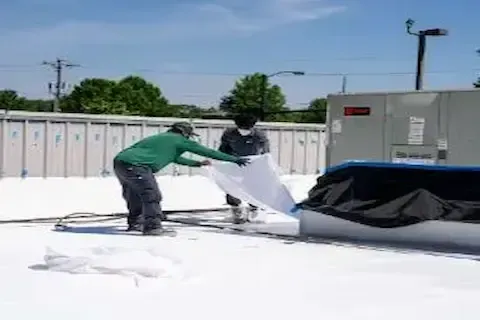
Patching vs Replacing Commercial Roofs Brooklyn Park
Every spring thaw and summer hailstorm forces Brooklyn Park commercial property owners into the same uncomfortable conversation: do you patch the damage you can see, or do you pull the trigger on a full replacement? The answer is rarely obvious from the ground level, and making the wrong call in either direction costs real money. Patch a roof that's already past its useful life and you'll be writing another check before the season ends. Replace a roof that had five solid years left and you've spent capital you didn't need to spend. Getting this decision right depends on a few concrete factors — and understanding them will save you from expensive regrets.
How Roof Age Changes the Math
The age of your existing membrane is the single most reliable starting point for any patch-versus-replace analysis. A standard TPO or EPDM flat roof installed correctly has a realistic service life of 20 to 30 years depending on maintenance history, sun exposure, and the number of Minnesota freeze-thaw cycles it has endured. Brooklyn Park sits in hardiness zone 4b, which means your roof faces significant thermal stress every year — temperatures swinging from negative twenty to over ninety degrees Fahrenheit within the same calendar year.
If your roof is under ten years old and the damage is localized — a storm seam, a puncture from fallen equipment, or a flashing failure around a rooftop unit — patching is almost always the financially sound choice. The underlying membrane still has structural integrity, and a properly executed repair will hold without compromise. Once a roof reaches the fifteen-to-twenty-year range, the calculus shifts. The membrane itself begins to lose elasticity, fasteners start backing out under thermal cycling, and what looks like one localized problem is often a symptom of systemic deterioration. At that point, every patch you apply is borrowed time.
Damage Scope and the 25 Percent Rule
Roofing contractors and building consultants commonly apply a practical benchmark: when damaged or saturated material exceeds roughly 25 percent of the total roof area, replacement is almost always more cost-effective than repair. This threshold exists because once water has migrated under a membrane in multiple zones, the substrate — typically polyiso insulation board — becomes compromised. Wet insulation loses its R-value, encourages mold growth between layers, and adds significant dead weight to your deck structure.
A detailed infrared moisture scan is the most reliable way to map actual saturation extent across a Brooklyn Park commercial roof. What looks like a single two-foot blister on a visual walkthrough can reveal an underlying moisture plume covering several hundred square feet when scanned after a warm afternoon. Many property owners are genuinely surprised by the difference between what they can see and what the scan reveals. Basing a repair decision purely on visual inspection without that data is one of the most common and costly mistakes in commercial roofing management.
For buildings along major corridors like 85th Avenue or around the Shingle Creek industrial areas, where rooftop HVAC equipment creates concentrated wear zones, this kind of hidden moisture migration is particularly common. Multiple penetrations and years of service technician foot traffic accelerate membrane fatigue in ways that only show up clearly under thermal imaging.
Lifecycle Cost Versus Upfront Spend
A patch repair on a commercial flat roof might run anywhere from a few hundred dollars for a minor flashing fix to several thousand dollars for a substantial membrane repair with new flashing and drainage corrections. A full replacement on a mid-sized Brooklyn Park commercial building — a 10,000 to 20,000 square foot footprint — typically runs into the tens of thousands of dollars depending on membrane type, insulation upgrade requirements, and deck condition.
The trap many owners fall into is comparing only those upfront numbers. The more useful comparison is total cost over the next ten years. If patching a fifteen-year-old roof extends its life by two more years before another repair is needed, then another repair after that, you may end up spending 60 to 80 percent of replacement cost in piecemeal repairs — while also absorbing interior damage costs, tenant disruption, and insurance complications that come with recurring leaks. Replacement, in that scenario, actually costs less over the planning horizon even though the check written today is larger.
Your Commercial Roof Repair options should always be evaluated against this longer view. A contractor who helps you run those numbers — not just quote the immediate job — is the one worth trusting.
When Patching Is Clearly the Right Call
There are situations where patching is straightforwardly correct and replacement would be premature. A relatively young roof with a single storm-related puncture or a failed seam at one specific flashing transition is a strong candidate for repair. The same applies when a previous roof tear-off and reinstall was done within the last decade and the installation quality was sound.
Rooftop equipment replacements often cause localized damage when contractors cut through membrane to modify curbs or reroute conduit. If the membrane surrounding that work zone is otherwise intact and in good condition, a targeted repair restores function without any justification for broader work. The key is having a credible assessment from someone who isn't financially incentivized toward the larger job — which is another reason a moisture scan and documented condition report from an independent source has real value before any significant decision is made.
Reading through the roof repair playbook gives you a solid framework for understanding what a proper repair scope should include and what warning signs in a contractor's proposal deserve a second look.
Local Permit and Code Considerations in Brooklyn Park
Brooklyn Park falls under Hennepin County jurisdiction for building permits, and the City of Brooklyn Park Building Inspections department enforces Minnesota State Building Code requirements for commercial roofing work. Full tear-off replacements typically require a permit, and in some cases an energy code compliance review applies — particularly when insulation is being replaced or upgraded as part of the project.
This matters for your decision because permit requirements add both cost and timeline to replacement projects. A full replacement on a larger commercial building in Brooklyn Park may require permit lead time of two to four weeks depending on current department load. If your building is actively leaking into occupied space, that timeline creates real risk. An emergency patch-and-stabilize approach to stop active water intrusion — followed by a planned replacement in a better season — is often the most operationally practical path forward when a roof has clearly failed but replacement can't happen immediately.
Making a Decision With Confidence
The patch-versus-replace question doesn't have a universal answer, but it does have a structured process. Start with documented roof age and installation history. Commission an infrared moisture scan if the roof is more than ten years old or if damage appears in more than one zone. Get a realistic cost projection for both repair and replacement across a ten-year horizon, not just today's invoice. Factor in your building's occupancy, any tenant lease obligations, and your own capital planning cycle.
Brooklyn Park commercial property owners who approach this decision methodically — rather than reactively, in the middle of an active leak — consistently make better calls and spend less money over the long run. The roof over your investment deserves the same analytical discipline you'd apply to any other capital expenditure.
